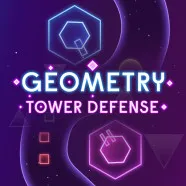





Geometry Tower Defense confronts players with a series of irreversible choices. The map doesn't tell you what to do; rather, it makes you act before you understand the whole picture.
A Fully Realized System
The winding paths resemble flowing currents that must be stemmed at precise points. You do not build to attack, but rather to slow down, fragment, and control. Each tower you place serves not only to address the immediate threat but also to influence subsequent waves. Consequently, the game does not unfold as a series of isolated waves, but rather as a gradually evolving system. Players are not merely clearing levels; they are meticulously refining a dynamic, evolving structure. When you realize you’ve made a mistake, you cannot simply undo it; you can only adapt and adjust. It is precisely this irreversibility that imbues every decision with a weight far greater than usual.
Intersections That Define The Battlefield
Not every location on the map holds equal importance—yet Geometry Tower Defense offers no explicit markers to indicate this. If you know how to take advantage of them, strategic value is multiplied at corners and lengthy expanses of road. Use your observation skills to determine where you can hold up enemies the longest. Tower positioning becomes an exercise in deduction rather than instinct; a little change may have a big impact. The game does not reward sheer volume of placements but rather the precision of placement. Every replaying feels incredibly experimental since you can't be certain your decisions will work until the following wave really starts. Every tower you place compels you to engage in deeper strategic thought when faced with uncertainty.
A Perspective On Speed
Changing the game's playback speed is a handy option, but it's not just for efficiency's sake. When accelerating, you are compelled to place your trust in the system you have built. When decelerating, you gain the opportunity to reflect and identify issues. This transforms speed into a tool for observation rather than a mere utility. Players can read the flow of the match in various ways, depending on the pace they choose. Instead of imposing a predetermined pace on you, the game gives you more agency over your processing speed. A fast-paced match may cause you to overlook details, while a slow-paced one can help you clearly spot vulnerabilities.
Endless Experiences